Two years ago, "AI for dental practices" meant a demo at a trade show booth. In 2026 it means features inside tools your office already pays for. NexHealth sends smarter recall messages. Practice-management platforms flag the open time slot a cancellation just created. FDA-cleared software reads radiographs alongside your hygienist. None of this showed up through the front door as a product called "AI." It arrived as an update to something you already use.
That quiet arrival is exactly why owners and office managers should be paying attention now. The decisions are not "should we buy AI." They are "which of our vendors are already processing our data with AI, what did we agree to, and who is checking the output."
Key takeaways
- The AI that matters in 2026 is already embedded in recall messaging, scheduling, insurance verification, and radiograph analysis tools. You are likely using more of it than you think.
- Any AI tool that touches patient information needs a signed Business Associate Agreement and a security review before it goes live, same as any other vendor.
- Staff pasting patient notes into a general-purpose chatbot is a real compliance risk. Set an explicit policy before it becomes a habit.
- Start with one workflow, measure it for 60 days, then decide. Piloting beats buying a suite.
Where AI is already earning its keep in dental practices
Recall and reactivation messaging
The front desk has always known which patients need to come back. The hard part is finding the time to call them. AI-assisted messaging tools now handle first-touch outreach: they read the schedule, pull the overdue recall list, and send messages that read like a person wrote them. The software books the appointment when the patient replies, and a human steps in only when the conversation gets complicated.
The practices that get good results do not fire and forget. Someone reviews what the tool sent last week, at least for the first couple of months. The tool learns from your corrections, and you learn where it sounds off.
Filling the holes in the schedule
A cancellation at 2 p.m. used to mean an empty chair and a phone marathon. Scheduling engines now watch the calendar, spot the gap, and rank the patients most likely to say yes to that specific time slot: someone due for a cleaning who lives nearby, a family with two kids due the same week. The office manager approves the send instead of hunting through the schedule manually.
This is the least glamorous AI in the building and possibly the most profitable. Two filled holes a week is real production.
Insurance verification
Verating eligibility has been a slow, portal-by-portal chore forever. AI verification services pull benefit details ahead of the visit, translate them into plain language, and flag the odd stuff: a missing waiting period, a frequency limitation, a plan that covers two cleanings a year but not the one scheduled. Estimates get more accurate, and patients stop being surprised at checkout.
Radiograph analysis
Software like Overjet and Denti.AI received FDA clearance to detect and outline caries on radiographs. This is not the machine making the diagnosis. It is a second pair of eyes that highlights areas on the image so the dentist can confirm or dismiss them.
Where this pays off is conversation, not diagnosis. A circled finding on a large monitor in the operatory gives you something concrete to point at while you explain why the watch-and-wait tooth became a filling. Practices report that patients accept more treatment when the evidence is on the screen instead of in the doctor's vocabulary.
Notes and phone handling
Voice-assisted charting is becoming workable for hygiene notes and perio charting. On the phone side, AI agents book recalls after hours and screen calls during them. The after-hours booking piece is the one with the clearest payoff: your front desk is not answering the phone at 9 p.m., and the patient comparison-shopping dentists at 9 p.m. usually books with whoever answers.
What this means for your IT setup
Here is the part nobody puts in the brochure: every AI tool you adopt becomes another integration in an already crowded stack. The recall platform needs to talk to your practice-management software. The verification service needs claims access. The scheduling engine needs calendar rights. Each connection is a data flow that someone has to secure, document, and keep working through every software update.
If your practice has a managed IT provider, loop them in before you sign, not after. A five-minute conversation about API access, sign-in policies, and where the data actually lives can save a month of cleanup later.
Three items belong on your checklist for any AI tool:
- A signed BAA. If the vendor processes patient information, the BAA is non-negotiable. A vendor that says its AI layer "doesn't need one" is telling you something important.
- A named security owner. Someone, internal or at your IT provider, knows how the tool authenticates, where its data sits, and what happens to it if you cancel.
- An output check. Pick one person who reviews the tool's work for the first 60 days. AI is confident even when it is wrong, and the mistakes are only cheap if a human catches them early.
One more thing, because we see it constantly: staff will discover general chatbots on their own, and someone will eventually paste a patient's chart note into one to "make it sound better." Free chatbot accounts have no BAA, and that paste may be a reportable disclosure of patient information. Put a simple written policy in place now: no patient information goes into any tool that is not on the approved list. Make it a training item, not a termination item, and give the team the approved alternative.
What AI still cannot do in a dental practice
The gap between what these tools do and what a practice needs is judgment. The recall tool does not know the patient whose husband just died and does not want a cheerful text this month. The insurance reader does not know the payer that pays the claim anyway when you attach a specific note, because you learned that in 2019. The radiograph software highlights the shadow, but the dentist decides whether it is decay, a ghost, or a cup that will resolve.
There is also the matter of accountability. If an AI-sent message promises a discount that does not exist, that is your practice's promise, not the vendor's. If a charting tool drops a line of a perio chart, the record is still your record. Everything these tools produce needs a human name attached to it before it counts.
Frequently Asked Questions
Which dental AI tools are FDA-cleared for radiograph analysis?
Radiograph analysis tools such as Overjet and Denti.AI have received FDA clearance for detecting findings like caries on dental images. Clearance means the software performs its stated detection function, not that it replaces the dentist's diagnosis. Your provider should keep a copy of the intended-use statement for anything reading clinical images in your office.
Do AI vendors need to sign a Business Associate Agreement with my practice?
Yes. Any vendor whose AI creates, receives, maintains, or transmits protected health information on your behalf is a business associate under HIPAA, and the agreement is required. This covers cloud recall tools, charting assistants, and scheduling engines. General-purpose chatbots with no BAA should never receive patient information.
How do I stop staff from pasting patient details into ChatGPT?
Adopt a short written policy that names the approved tools and states that no patient information goes into anything else, then review it in a staff meeting. Pair the rule with a compliant alternative for the underlying task, such as an approved AI writing assistant under BAA. Most violations are convenience, not malice, so make the compliant path the easy path.
Conclusion
The practices doing well with AI in 2026 are not the ones that bought the most of it. They are the ones that picked one workflow, measured it, kept the human in the loop, and ran the vendor paperwork through the same process they use for everything else that touches patient data. Treat every AI feature like the software integration it actually is, and the upside is real: fuller schedules, fewer surprise estimates, and a front desk that spends its time with patients instead of with portals.
If you are weighing a specific AI tool and want a second opinion on the security and compliance side before you sign, that is a conversation we have with clients every week. Our managed IT services include vendor reviews, or you can go straight to the FAQ for the common questions.
Sources/References
- U.S. Food and Drug Administration, Digital Health Center of Excellence: https://www.fda.gov/medical-devices/digital-health-center-excellence
- U.S. Department of Health and Human Services, HIPAA and business associates: https://www.hhs.gov/hipaa/for-professionals/privacy/guidance/business-associates/index.html
- HHS Office for Civil Rights, Security Rule guidance: https://www.hhs.gov/hipaa/for-professionals/security/index.html
Related Reading
Dental Office Cybersecurity Assessment Checklist for Owners
Most dental practices carry serious security gaps they do not know about — outdated firmware, unmanaged endpoints, and unprotected email. Work through this owner-friendly checklist to see exactly where your practice stands.
READ MORE →
How to Plan Computers, Networks, and Software for a New Dental Office
A new dental office lives or dies by the technology plan laid before the walls go up. This guide covers workstations, network, server room, imaging, and software decisions — with a realistic timeline from lease signing to opening day.
READ MORE →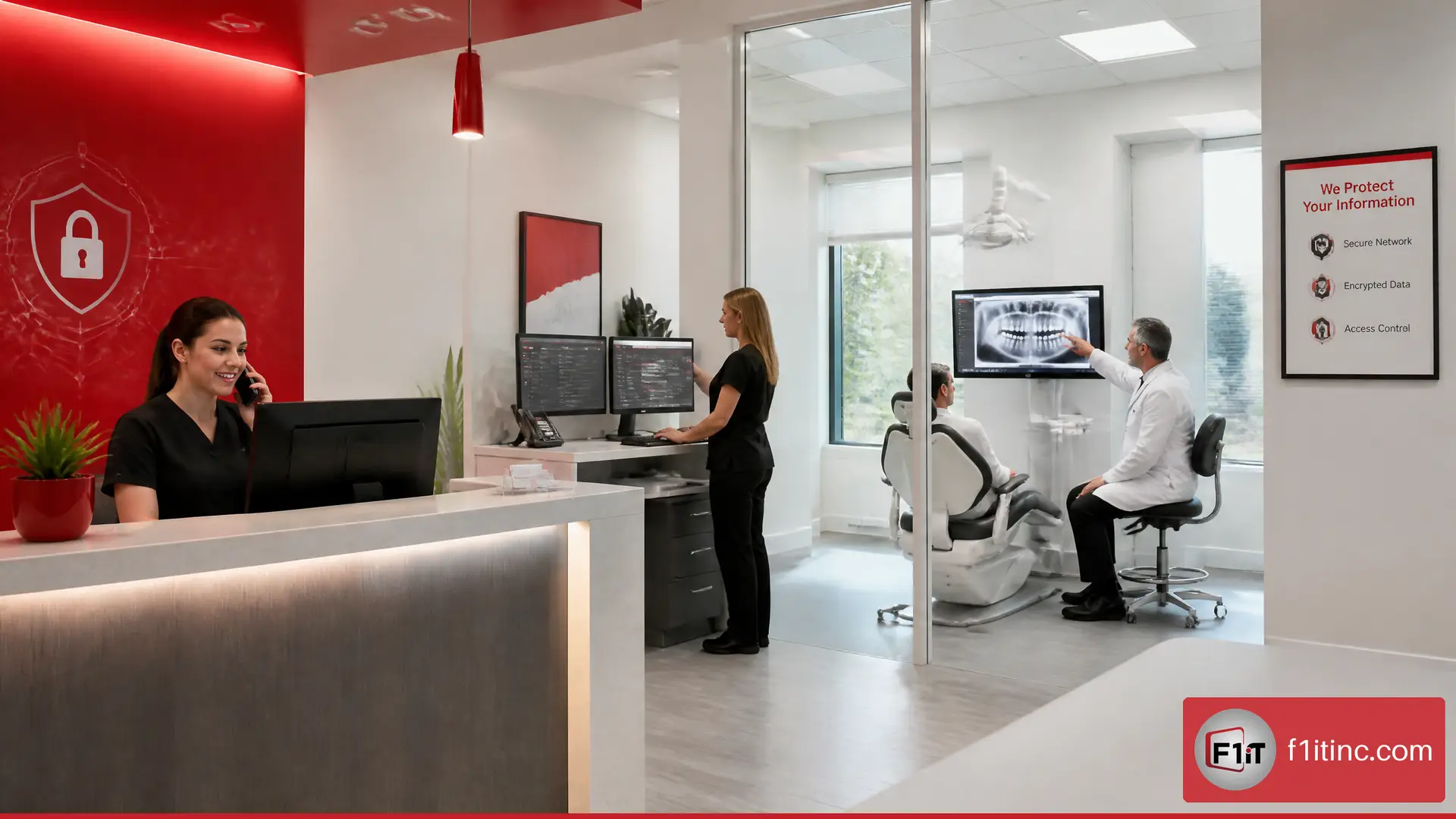
How Managed IT Support Improves Dental Office Operations
Practices on managed support plans resolve issues faster, suffer less downtime, and spend far less on emergency repairs. Here is what actually changes operationally when your IT is monitored and maintained instead of fixed when it breaks.
READ MORE →